DICP Researchers Highlight the Role of In Situ/Operando Mössbauer Spectroscopy in Unraveling Dynamic Mechanisms of Single-Atom Catalysis
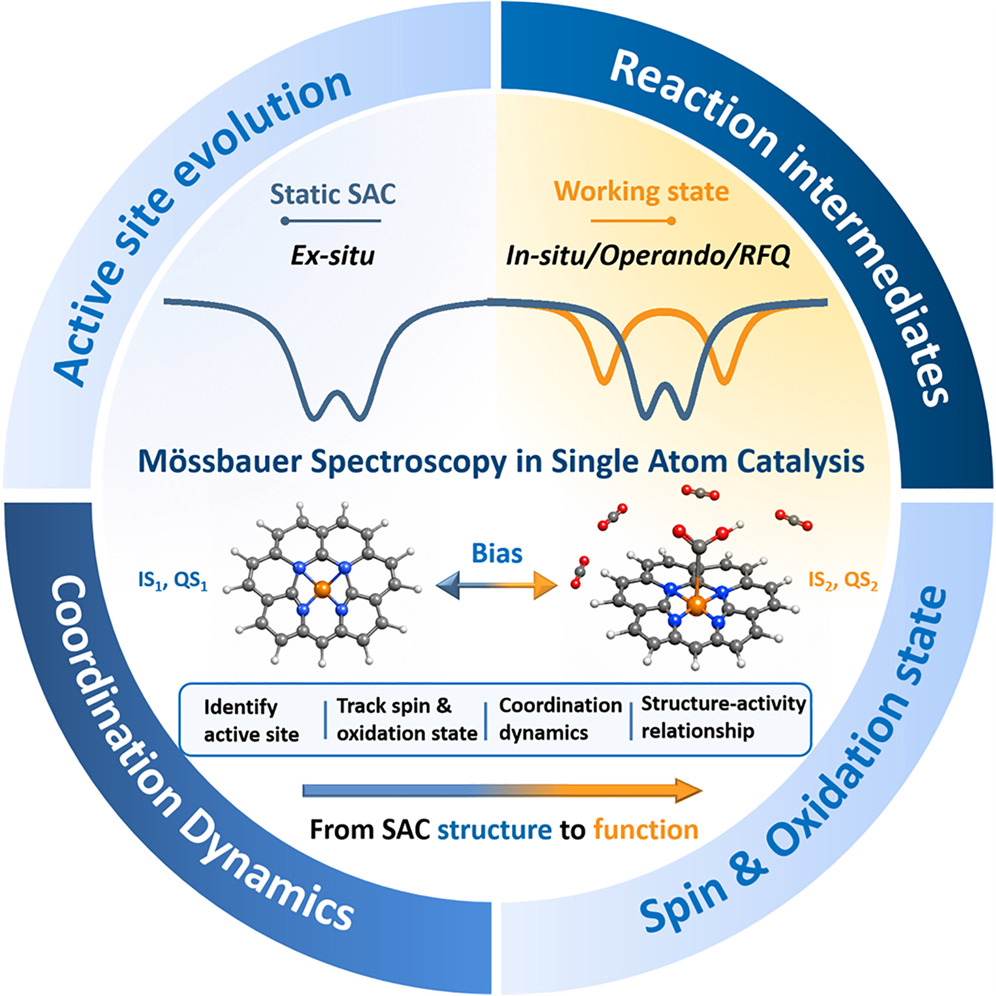
Recently, a research team led by Prof. Tao Zhang, Prof. Yanqiang Huang, and Prof. Xuning Li from the Dalian Institute of Chemical Physics (DICP) of the Chinese Academy of Sciences published a Perspective article in Chem, entitled "In situ/operando Mössbauer spectroscopy in single-atom catalysis: From structure-activity relationships to dynamic mechanisms." The article systematically reviews recent advances in applying in situ/operando and rapid-freeze-quench (RFQ) Mössbauer spectroscopy to single-atom catalysts (SACs), highlighting their unique capabilities in identifying dynamic changes in oxidation states, spin states, and coordination environments under working conditions.
Understanding the Dynamic Nature of Single-Atom Catalysts
Since the pioneering development of single-atom catalysis in 2011, SACs have attracted considerable attention due to their high atomic utilization efficiency, well-defined active sites, and tunable coordination environments. They have been widely investigated in thermal, photocatalytic, and electrocatalytic reactions.
However, the atomic structures of SACs are not necessarily static during catalysis. Under realistic reaction conditions, isolated metal sites may undergo dynamic changes in oxidation states, spin configurations, coordination environments, and local structures. Such transformations can significantly influence catalytic activity, selectivity, and stability.
Although advanced characterization techniques, including X-ray absorption spectroscopy (XAS), X-ray photoelectron spectroscopy (XPS), and vibrational spectroscopy, have provided valuable insights into catalyst structures, quantitatively identifying different active-site configurations and tracking their evolution under working conditions remain challenging.
Mössbauer spectroscopy offers a powerful approach to addressing these challenges. For Mössbauer-active isotopes such as 57Fe and 119Sn, hyperfine parameters are highly sensitive to the local electronic and geometric environments of metal centers. The isomer shift (IS) provides information on electron density at the nucleus, oxidation states, and metal–ligand interactions, while quadrupole splitting (QS) reflects local symmetry and coordination environments. Magnetic hyperfine interactions further help distinguish isolated metal sites from magnetically ordered clusters or nanoparticles.
By combining in situ/operando measurements with RFQ techniques, researchers can monitor structural evolution during catalysis and capture metastable intermediates that might otherwise escape detection.
Tracking Active-Site Evolution in Fe-Based Single-Atom Catalysts
The Perspective highlights representative applications of 57Fe Mössbauer spectroscopy in Fe-based SACs, particularly for the oxygen reduction reaction (ORR) and electrochemical CO2 reduction reaction (CO2RR).
For Fe-N-C catalysts, in situ Mössbauer spectroscopy has revealed that structurally distinct FeN4 sites exhibit different catalytic activities and stabilities. In acidic ORR, certain pyrrolic FeN4 configurations display high catalytic activity but are more susceptible to demetallation and structural degradation. In contrast, more stable FeN4 configurations can contribute significantly to long-term catalytic performance.
Potential-dependent Mössbauer measurements further reveal reversible changes in Fe oxidation states, spin configurations, and adsorbate coordination. These observations demonstrate that the most active catalytic sites are not necessarily the most stable ones, emphasizing the importance of identifying active-site evolution rather than relying solely on ex situ structural characterization.
The article also discusses the role of spin-state regulation in Fe-based CO2RR catalysts. For example, Fe phthalocyanine-based systems can undergo potential-induced transformations between Fe(III) and Fe(II) states, accompanied by changes in spin configurations and axial coordination. The formation of specific low-spin or high-spin Fe intermediates can be correlated with CO production, providing insights into the relationship between electronic structure and catalytic selectivity.
These studies demonstrate that Mössbauer spectroscopy can distinguish catalytically relevant Fe species from spectator sites and degradation products, thereby establishing a more reliable connection between active-site structures and reaction pathways.
Revealing Reaction-Induced Transformations in Sn-Based Catalysts
Beyond Fe-based systems, the Perspective emphasizes the application of 119Sn Mössbauer spectroscopy to Sn-containing catalysts for electrochemical CO2 reduction.
Unlike many FeN4 systems, in which the primary coordination framework can remain largely intact during catalytic turnover, Sn-containing catalysts frequently undergo more extensive potential-induced coordination changes and phase transformations.
RFQ Mössbauer spectroscopy has enabled the identification of transient Sn species under different applied potentials. In representative Cu1/SnS2 and Ir1-SnO2 systems, electrochemical reduction induces the formation of partially reduced Sn species and metallic Sn, accompanied by changes in the surrounding coordination environments.
By quantitatively monitoring the relative populations of Sn(IV), Sn(II), SnO-related species, and metallic Sn, researchers can correlate catalyst reconstruction with changes in CO2RR product selectivity.
These findings indicate that reaction-induced structural transformations may play a decisive role in determining catalytic performance. Rather than treating catalyst reconstruction solely as a degradation process, such transformations can also generate catalytically relevant interfaces and active configurations.
Integrating Mössbauer Spectroscopy with Theoretical Calculations and Complementary Techniques
A major emphasis of the Perspective is the integration of Mössbauer spectroscopy with density functional theory (DFT) calculations and complementary operando characterization methods.
Although Mössbauer hyperfine parameters provide sensitive fingerprints of local electronic and geometric structures, assigning individual spectral components to specific atomic configurations can be challenging, particularly when multiple species exhibit overlapping signals.
DFT calculations can predict IS and QS values for candidate atomic structures, allowing experimental spectra to be compared with theoretical models. This combined approach helps distinguish different FeN4 coordination configurations, identify transient Sn-containing intermediates, and clarify the relationship between oxidation states, spin states, and local bonding environments.
Furthermore, complementary techniques such as XAS, XPS, electron paramagnetic resonance (EPR), Raman spectroscopy, and attenuated total reflection surface-enhanced infrared absorption spectroscopy (ATR-SEIRAS) provide additional information on metal coordination, electronic states, and adsorbed reaction intermediates.
The integration of these techniques is essential for distinguishing genuine catalytic active sites from spectator species, degradation products, and transient intermediates.
Future Perspectives
The article outlines several promising directions for advancing Mössbauer spectroscopy in single-atom catalysis.
First, extending in situ/operando and RFQ measurements to more realistic reaction environments, including gas-diffusion electrodes and high-current-density electrochemical systems, will help bridge the gap between laboratory studies and practical applications.
Second, improving temporal resolution and developing advanced synchrotron-based techniques, such as synchrotron Mössbauer sources (SMS), nuclear forward scattering (NFS), and nuclear resonance vibrational spectroscopy (NRVS), could expand the range of accessible catalytic states and structural information.
Third, integrating experimental hyperfine parameters with DFT calculations, comprehensive spectral databases, and machine-learning approaches may facilitate more reliable structural assignments and accelerate the rational design of catalytic active sites.
Finally, extending these approaches to additional catalytic reactions and more complex metal coordination environments will broaden their applicability in heterogeneous catalysis.
Overall, this Perspective highlights a fundamental shift in the characterization of single-atom catalysts: from identifying static structures before or after reaction to quantitatively tracking the dynamic evolution of active sites under operating conditions.
By revealing how oxidation states, spin configurations, and coordination environments evolve during catalysis, in situ/operando Mössbauer spectroscopy provides valuable mechanistic insights for the rational development of more active, selective, and durable single-atom catalysts.
The Perspective was published in Chem under the title "In situ/operando Mössbauer spectroscopy in single-atom catalysis: From structure-activity relationships to dynamic mechanisms" (Chem, 2026, 12, 103291). El Mehdi Chatir is the first author, and Prof. Xuning Li, Prof. Yanqiang Huang, and Prof. Tao Zhang are the corresponding authors.
Publication: Chem (2026), 12, 103291
DOI: https://doi.org/10.1016/j.chempr.2026.103291

