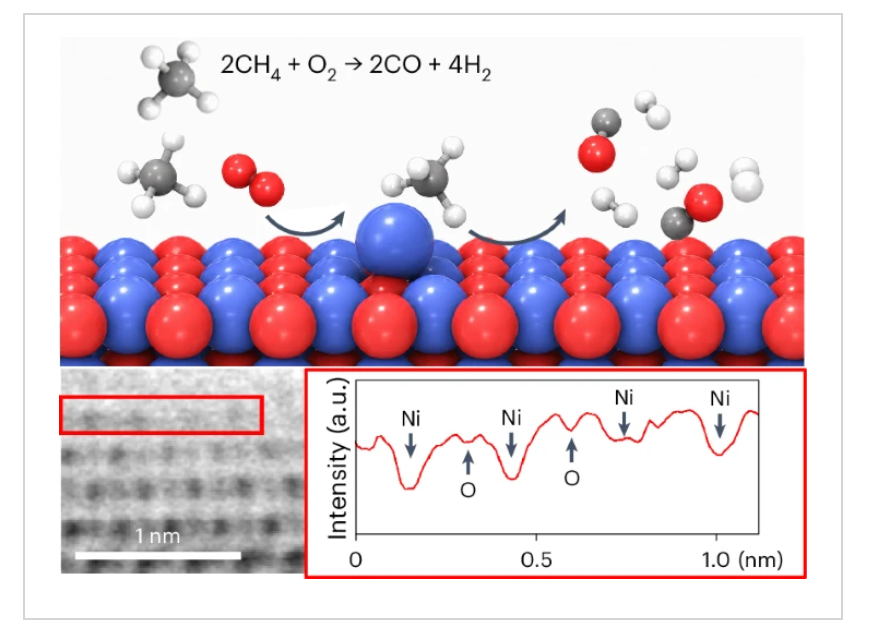
Partial oxidation of methane (POM) to syngas is an important industrial reaction that converts CH4 and O2 into CO and H2, providing basic feedstocks for processes such as Fischer–Tropsch synthesis, oxygenate production, and ammonia synthesis. Compared with noble-metal catalysts, Ni-based catalysts are less expensive and have high activity potential, and have therefore long been regarded as key candidate systems for the POM reaction.
For a long time, high-loading metallic Ni nanoparticles have generally been considered the key active phase for POM, whereas NiO has often been regarded as a species responsible for complete oxidation or catalyst deactivation. However, in high-loading systems, the metallic Ni observed after reaction may be generated through reduction by syngas and does not necessarily represent the true working-state active structure.
Therefore, directly identifying the oxidation state, structural evolution, and genuine active sites of Ni species under reaction conditions is crucial for redefining the catalytic mechanism of Ni-based POM.
Recently, Xiaoyan Liu, Wei Liu, and Tao Zhang from the Dalian Institute of Chemical Physics, Chinese Academy of Sciences, Tao Yang from Xi’an Jiaotong University, and Graham J. Hutchings from Cardiff University, UK, published a research article entitled “In situ generation of active motifs on Ni/Al2O3 during partial oxidation of methane to syngas” in Nature Catalysis. Yuanlong Tan, Qiao Zhao, and Chen Liang are co-first authors of the paper, while Xiaoyan Liu, Wei Liu, Tao Zhang, Tao Yang, and Graham J. Hutchings are co-corresponding authors.
Core Highlights
1. This study challenges the conventional view that metallic Ni is the active phase in Ni-based methane partial oxidation, showing that metallic Ni is rapidly oxidized to NiO under steady-state reaction conditions.
2. The research team prepared a 0.8 wt% Ni/Al2O3-ME catalyst using a microemulsion method, achieving 92.0% CH4 conversion and 87.0% CO/H2 selectivity at 650 °C.
3. Operando XAS, quasi-in situ XPS, and ETEM collectively demonstrate that steady-state metallic Ni cannot be detected under POM reaction conditions and that the catalyst mainly exists in the form of NiO.
4. AC-ESTEM captured, at the atomic scale, isolated undercoordinated Ni atoms generated in situ on the NiO(100) surface, forming a [Ni1O1Ni4] surface structure.
5. DFT calculations show that the [Ni1O1Ni4] site lowers the activation barrier for the first C–H bond cleavage of CH4 to 12.5 kcal mol-1, showing higher activity than Ni(111) and conventional NiO(100).
📄 Full Article Overview
The active phase for methane partial oxidation to syngas over Ni catalysts has generally been attributed to metallic nanoparticles, with a high Ni loading of approximately 10 wt% considered necessary.
This study demonstrates that [Ni1O1Ni4] motifs generated in situ on the NiO surface can efficiently drive the POM reaction, in which one Ni atom is located above an oxygen atom that connects four surrounding Ni atoms.
The 0.8 wt% Ni/Al2O3-ME catalyst, prepared by depositing preformed Ni nanoparticles onto Al2O3, achieved 92.0% CH4 conversion and 87.0% CO/H2 selectivity at 650 °C, while maintaining a stable H2/CO ratio of 2.0.
Operando spectroscopy and environmental electron microscopy confirmed that metallic Ni is oxidized to NiO during POM. Operando high-resolution annular bright-field imaging combined with DFT calculations showed that the [Ni1O1Ni4] structure formed on the NiO(100) surface can lower the C–H activation barrier to 12.5 kcal mol-1. Therefore, high loadings of metallic Ni nanoparticles are not strictly necessary for efficient POM reactions.
📊 Figure-by-Figure Interpretation
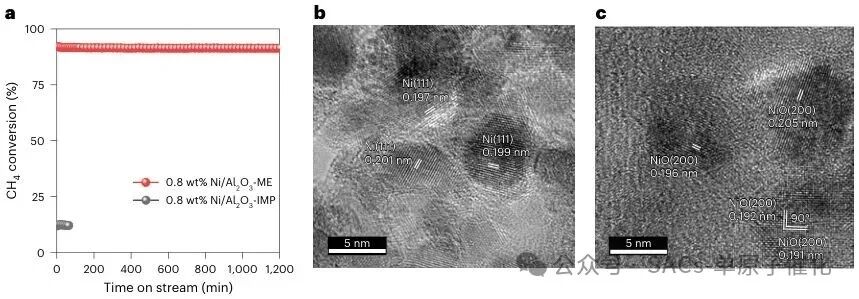
Figure 1 | Ni/Al2O3-ME exhibits high methane conversion and syngas selectivity in POM, while Ni transforms from the metallic state to NiO after reaction.
The results show that 0.8 wt% Ni/Al2O3-ME achieves 92.0% CH4 conversion at 650 °C, with both CO and H2 selectivities reaching 87.0% and a stable H2/CO ratio of 2.0. In comparison, the impregnation-prepared catalyst with the same Ni loading exhibits only 12.5% conversion and produces no syngas. HRTEM further shows that the catalyst consists of metallic Ni nanoparticles before reaction, whereas they transform into NiO and undergo a certain degree of particle growth after reaction.
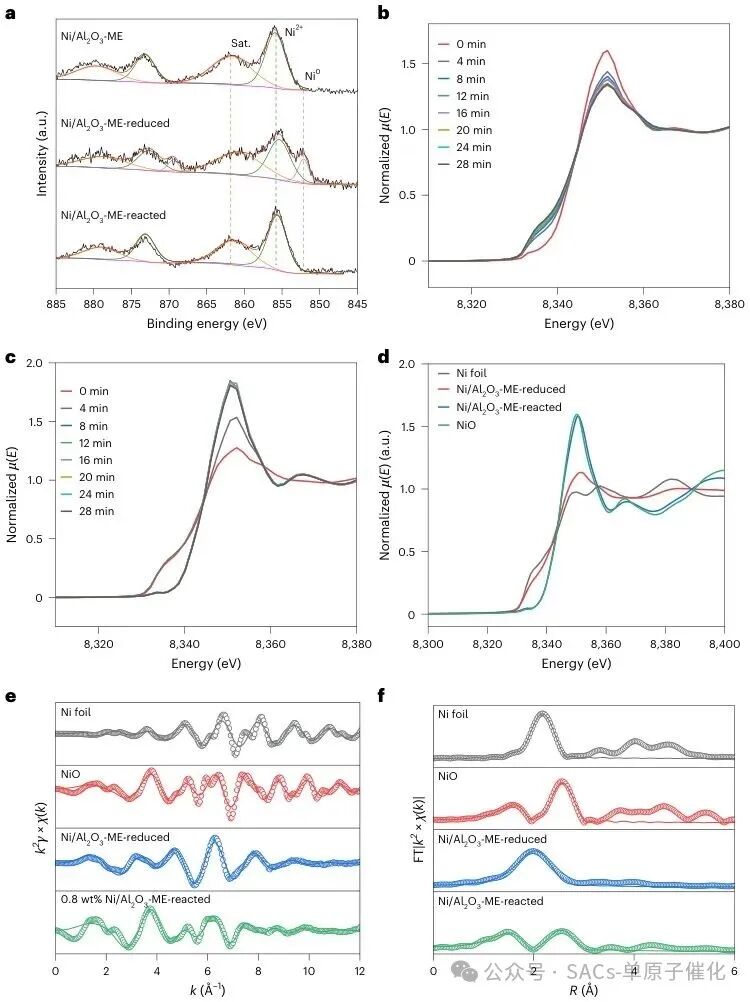
Figure 2 | Quasi-in situ XPS and operando XAS reveal that metallic Ni is generated after reduction but is reoxidized to NiO under steady-state POM conditions.
Quasi-in situ XPS shows that Ni2+ is the predominant species in the initial Ni/Al2O3-ME catalyst. After H2 reduction, a Ni⁰ peak appears, whereas exposure to POM conditions results in complete reoxidation of Ni, with only Ni2+ being detected.
Operando XANES and EXAFS also demonstrate that the local Ni structure evolves from the reduced state toward NiO-like characteristics during the reaction, indicating that metallic Ni is not the detectable dominant active phase under steady-state POM conditions.
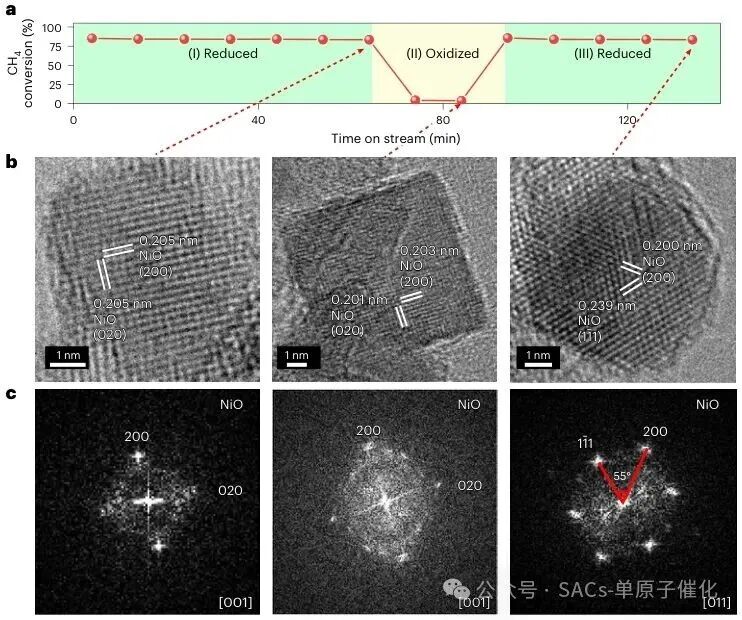
Figure 3 | Reduction–oxidation–re-reduction cycling and HRTEM demonstrate that conventional pre-oxidized NiO lacks POM activity and that the active structure must be generated in situ during the reaction.
Control experiments show that the catalyst maintains high activity in POM after H2 reduction. Following short-term O2 oxidation, CH4 conversion decreases to approximately 10%, the products shift toward CO2, and POM activity disappears. After H2 reduction again, the catalytic performance is restored.
HRTEM and FFT results show that NiO lattice-plane information can be observed at different stages, indicating that simply preforming NiO is insufficient to catalyze POM and that the true active structure should originate from surface reconstruction under reaction conditions.
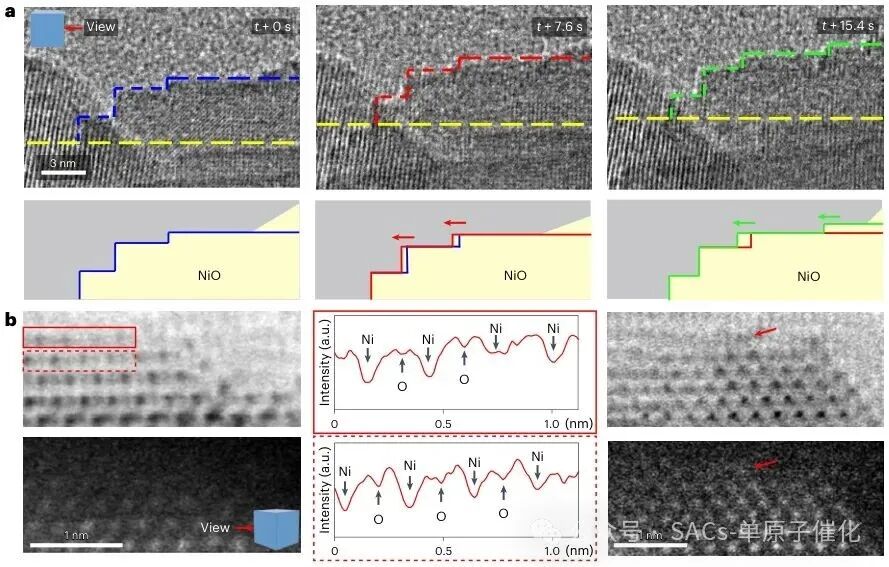
Figure 4 | High-resolution environmental electron microscopy directly observes the evolution of Ni particles into NiO and identifies atomic-scale [Ni1O1Ni4] reconstruction features on the NiO surface.
ETEM shows that after introduction of the POM atmosphere, metallic Ni nanoparticles undergo changes in morphology and size within several minutes and gradually stabilize as NiO nanoparticles.
AC-ESTEM further reveals Ni–O coordination reconstruction along the NiO (110) direction and identifies an isolated Ni atom located above a surface oxygen atom and surrounded by four Ni atoms, providing atomic-scale evidence for the [Ni1O1Ni4] active site.
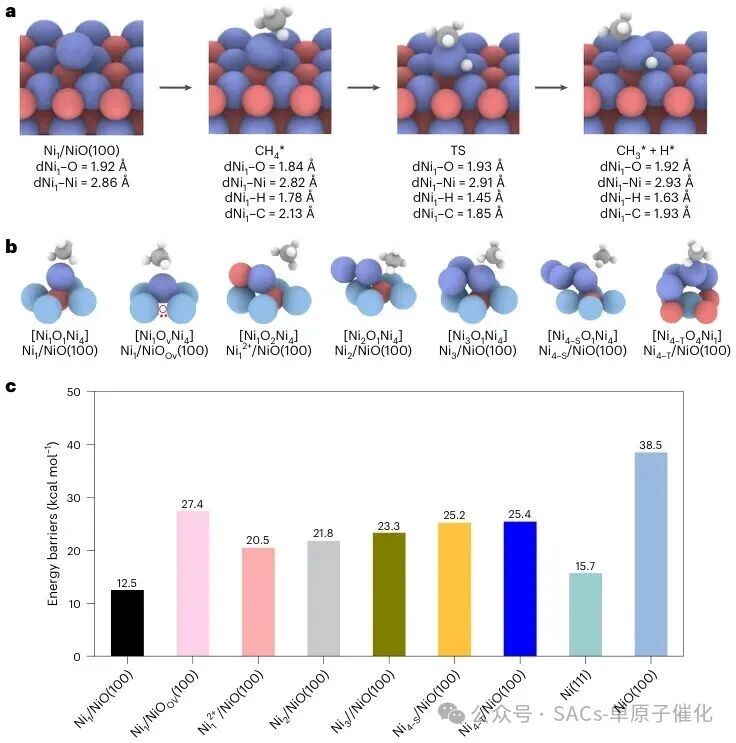
Figure 5 | DFT calculations demonstrate that the [Ni1O1Ni4] site significantly lowers the activation barrier for the first C–H bond cleavage of CH4 and represents a more active structure than Ni(111) and NiO(100).
DFT results show that the Ni1/NiO(100) surface can thermodynamically stabilize the [Ni1O1Ni4] structure and reduce the barrier for the first C–H bond cleavage of CH4 to 12.5 kcal mol-1.
In comparison, the barrier on conventional NiO(100) is as high as 38.5 kcal mol-1, while that on Ni(111) is 15.7 kcal mol-1, demonstrating that the isolated Ni site generated in situ on the NiO surface is more favorable for methane activation.
📝 Summary
This study observes that [Ni1O1Ni4] motifs are generated in situ on the NiO surface under reaction conditions and that these motifs are associated with catalytic activity for the partial oxidation of methane to syngas, differing from the conventional interpretation that metallic Ni nanoparticles are the active species.
Through advanced characterization techniques including operando XAS, quasi-in situ XPS, ETEM, AC-ESTEM, and DFT calculations, the research team demonstrates that preformed metallic Ni nanoparticles are oxidized to NiO under POM conditions, while the catalyst still exhibits significant catalytic performance, achieving 92.0% CH4 conversion and 87.0% syngas selectivity at 650 °C.
AC-ESTEM suggests that the in situ generated [Ni1O1Ni4] structure is a possible active site that can significantly lower the C–H activation barrier to 12.5 kcal mol-1, exhibiting higher activity than metallic Ni(111) and NiO(100).
This work not only redefines the active phase in Ni-based POM catalysts but also provides a new framework for designing highly efficient catalytic systems for other redox reactions.
In situ generation of active motifs on Ni/Al2O3 during partial oxidation of methane to syngas, Nature Catalysis, 2026, DOI: 10.1038/s41929-026-01580-1.
Reproduced from the WeChat official account “Nanostructured Materials”. Original article link:
https://mp.weixin.qq.com/s/UCto3n7bvEBTr_sNxwjgnA

