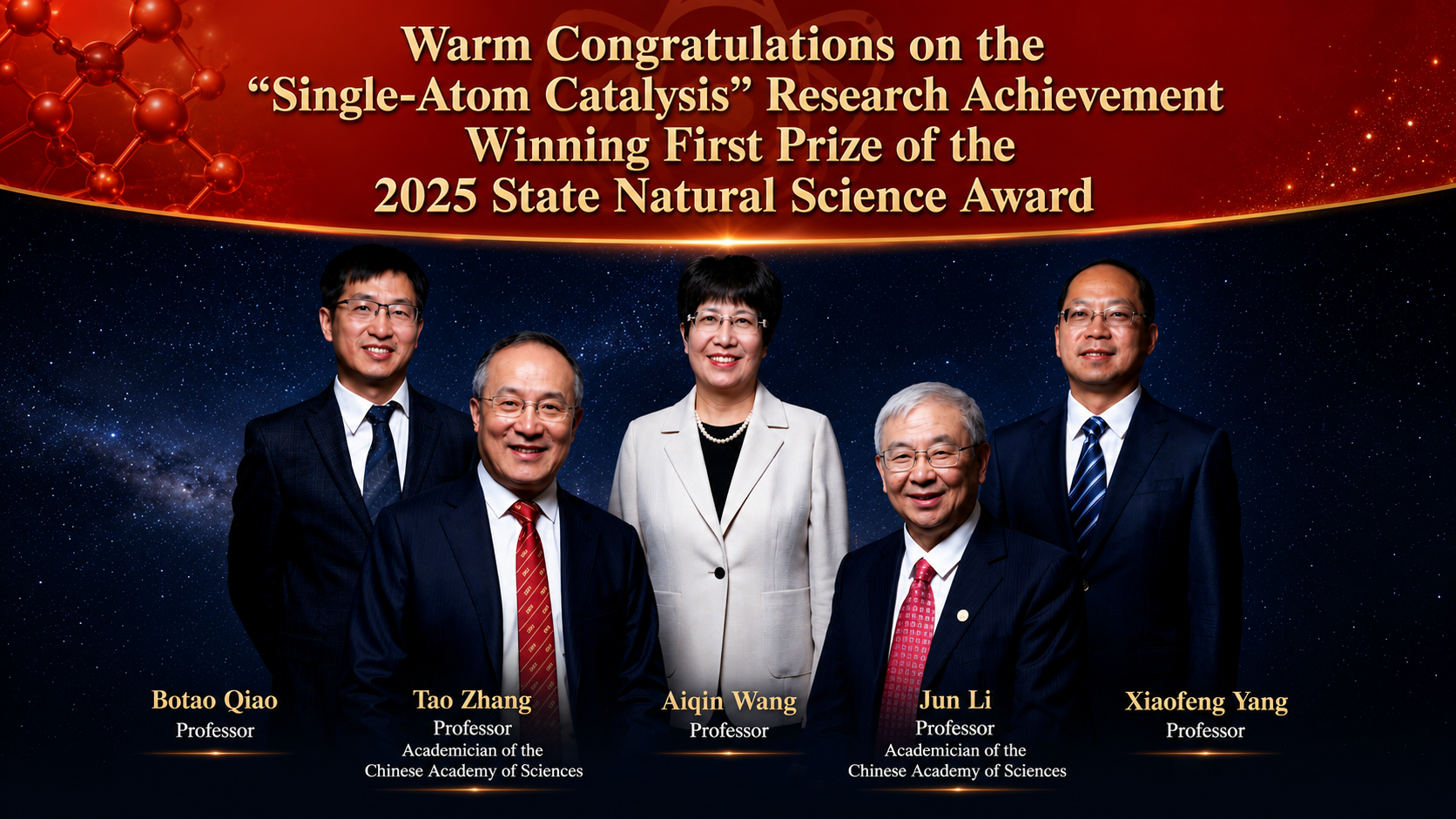
July 8th,the 2025 National Science and Technology Awards Conference was grandly held in Beijing. The achievement in "Single-Atom Catalysis" and the achievement in "Key Technologies and Applications of a New Generation of Large-Scale All-Vanadium Flow Batteries" from the Dalian Institute of Chemical Physics (DICP), Chinese Academy of Sciences, were respectively awarded the First Prize of the 2025 State Natural Science Award and the Second Prize of the State Technological Invention Award.
Achievement in “Single-Atom Catalysis”
Heterogeneous catalysis, as the cornerstone of the modern chemical industry, plays an essential role in energy conversion, materials synthesis, environmental protection, human health, and many other fields. At its core, heterogeneous catalysis is a process in which reactants are accelerated toward products through the action of “active sites”. The number, structure, and chemical environment of these active sites largely determine catalytic activity and selectivity. Therefore, the precise construction of active sites at the atomic level with maximized metal utilization efficiency has long been a central goal yet a formidable challenge in the field of heterogeneous catalysis.
Since the 1990s, Prof. Tao Zhang’s group at DICP has been devoted to fundamental studies on supported highly dispersed metal catalysts, with a long-term objective to understand catalytic processes and ultimately realize the rational design and regulation of catalysts at the atomic level. After nearly two decades of dedicated research and sustained efforts, the team successfully prepared the first practical supported single-atom catalyst, Pt1/FeOx, in 2009. In collaboration with Professor Jun Li at Tsinghua University and Professor Jingyue Liu at Arizona State University, they proposed the concept of "Single-Atom Catalysis (SAC)"in 2011. Following the establishment of this concept, the team systematically expanded the reaction scope of single-atom catalysis, elucidated its intrinsic characteristics and catalytic mechanisms, and developed theoretical understandings of the stability of single-atom catalysts. These efforts promoted the evolution of SAC from an original concept to a widely recognized scientific field.
SAC can, in principle, maximize the utilization efficiency of metal atoms. Of more importance, single-atom catalysis has advanced the understanding of “active sites” in heterogeneous catalysis from the traditional micro- and nanoscale to the atomic scale, thereby laying an important foundation for atomically precise catalysis. SAC has opened a new direction in heterogeneous catalysis and has driven and led the development of catalytic science.
Guided by the concept of SAC, Chinese scientists have taken the lead in realizing the scale-up application and industrial demonstration of single-atom catalysts. The team led by Professor Ying Li at Zhejiang University of Technology developed a new generation of ultra-stable, low-mercury single-atom catalysts and completed a ten-thousand-ton-scale industrial demonstration for vinyl chloride production, providing important technical support for the upgrading of China’s polyvinyl chloride industry. The teams led by Professors Yunjie Ding and Li Yan at DICP successfully developed porous organic polymer-supported rhodium single-atom catalysts with dual functions as both support and ligand. These catalysts were applied to heterogeneous hydroformylation of olefins, enabling the industrialization of a 50,000-ton-per-year technology for heterogeneous ethylene hydroformylation followed by hydrogenation to produce n-propanol. This achievement solved long-standing challenges in the heterogenization of homogeneous catalysis over the past 80 years, including the loss of ligands and active metal components. In addition, single-atom catalysts have also been applied in synthesis of fine chemicals, aerospace catalysis, and other fields.
The achievement of "Single-Atom Catalysis" recognized by this First Prize mainly comprises three aspects: the proposal of the new concept of SAC, the expansion of reaction types and elucidation of mechanisms, and the development of theoretical understandings of catalyst stability. This achievement was jointly completed by Prof. Tao Zhang at DICP, Prof. Jun Li at Tsinghua University, and Profs. Aiqin Wang, Botao Qiao, and Xiaofeng Yang at DICP. As the core and cornerstone of this achievement, single-atom catalysis represents an original scientific concept proposed and systematically developed by Chinese researchers, and stands as one of the few major concepts in the century-long history of catalysis science that originated in China and gained broad international recognition.

