Spillover is one of the key dynamic features in heterogeneous catalysis. In simple terms, it refers to the diffusion and migration of active species between the supported metal and the catalyst support, a process that directly affects catalytic efficiency and reaction outcomes. Recently, a team led by Prof. Tao Zhang and Prof. Yanqiang Huang at the Dalian Institute of Chemical Physics (DICP) of the Chinese Academy of Sciences, in collaboration with Prof. Wei Liu and Associate Prof. Yanggang Wang from Southern University of Science and Technology, made an important breakthrough in the understanding of spillover effects in heterogeneous catalysis.For the first time, the researchers directly observed and confirmed, at the atomic scale, the phenomenon of bulk oxygen spillover controlled by the metal/support interface. They further clarified its crucial role in heterogeneous catalytic reactions and, based on this discovery, proposed a new “surface–interface–bulk” synergistic catalytic mechanism for metal–support systems. The related study was published in Nature on April 15, Beijing time.
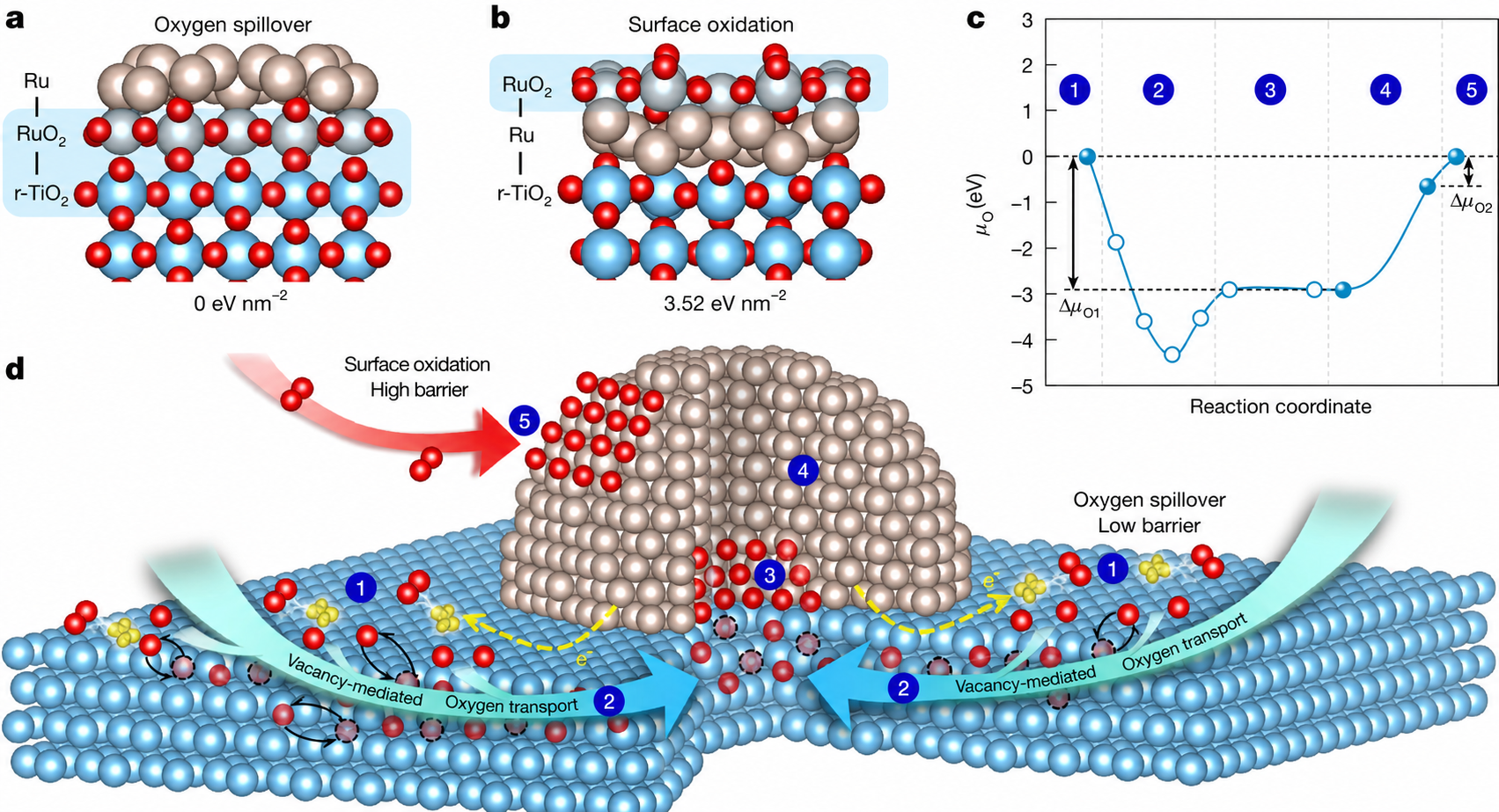
To date, spillover behavior on catalyst surfaces has been extensively studied. However, whether a similar spillover process exists in the bulk phase of supported metal catalysts—especially across the metal/support interface—and how such a process influences catalytic reactions have remained unresolved questions. In this work, the research team focused on the development of high-performance supported Ru-based catalysts. Using atomically resolved environmental transmission electron microscopy, they achieved in situ atomic-scale visualization of the oxidation process of individual Ru particles in Ru/rutile-TiO2 and, for the first time, observed bulk oxygen spillover during this process. Their results confirmed that lattice oxygen in the support can migrate to the metal particles through the interface via a vacancy-mediated transport pathway.Meanwhile, the team developed a picometer-precision atomic strain vector analysis method, which enabled high-resolution and quantitative characterization of oxygen spillover behavior. They also tracked the local dynamic lattice strain in the support induced by continuous oxygen transport across the interface. These findings revealed how the metal/support interface regulates bulk oxygen spillover and demonstrated that interfacial structural matching is essential for maintaining an efficient bulk oxygen spillover channel. This mechanism was shown to be broadly present in catalyst systems featuring metal/support oxide interfaces with low lattice mismatch, where it plays a key role in catalytic reactions.
Based on direct microscopic visualization, this study uncovers a new catalytic mechanism involving the participation of the three-dimensional bulk phase in metal–support systems and highlights the critical role of interface structure in governing the migration of reactive species. The work provides new fundamental insights for the design of heterogeneous catalytic interfaces and for understanding the dynamic features of catalytic reactions.
https://www.nature.com/articles/s41586-026-10324-x

