Tao Zhang’s Team Clarifies the Conceptual Boundary Between Single-Site and Single-Atom Catalysts in Nature Reviews Chemistry
Recently, a team led by Prof. Tao Zhang from the Dalian Institute of Chemical Physics (DICP), Chinese Academy of Sciences, in collaboration with Prof. Graham J. Hutchings from Cardiff University, published a Comment article entitled “Distinguishing single-site from single-atom catalysts” in Nature Reviews Chemistry.
The article addresses the widespread conflation of the terms single-atom catalyst (SAC) and single-site catalyst (SSC) in the rapidly developing field of single-atom catalysis. By revisiting their conceptual origins, structural distinctions, and experimental criteria, the authors systematically clarify the boundaries between the two catalyst classes and propose standardized characterization benchmarks and guidelines for terminology.
The central conclusion is straightforward: the “single” in a single-atom catalyst refers to the geometric isolation of individual metal atoms, whereas the “single” in a single-site catalyst refers to the structural and energetic equivalence of all active sites. The two concepts are therefore not synonymous, but instead describe two partially overlapping categories of catalysts.
01 Why the distinction matters
Active sites lie at the heart of heterogeneous catalysis. As early as 1925, Taylor introduced the concept of catalytic active sites. However, for most supported metal catalysts, particle size, morphology, and surface microstructure are intrinsically heterogeneous, while the active structure may also evolve dynamically under reaction conditions. Such complexity makes it difficult to establish clear structure–activity relationships or to unravel catalytic mechanisms at the atomic scale.
Against this background, single-site catalysts and single-atom catalysts developed along two distinct scientific trajectories.Single-site catalysts were inspired by homogeneous molecular catalysts and enzymes, where catalytically active centers are structurally well defined and mutually equivalent. The goal was to reproduce such uniform active centers in solid materials. Single-atom catalysts, by contrast, emerged from the progressive downsizing of supported metal nanoparticles, with the aims of maximizing metal atom utilization and exploring the unique catalytic properties of isolated metal atoms.
Because both types of materials may contain highly dispersed metal centers, the two terms have sometimes been used interchangeably in the literature. However, overlooking the different emphasis embedded in their definitions can lead to a critical misconception: directly imaging isolated atoms does not necessarily prove that all catalytic sites are identical. Such confusion can compromise mechanistic interpretations and hinder meaningful comparison between different catalytic systems.
02 What distinguishes single-atom catalysts from single-site catalysts?
A single-atom catalyst (SAC) requires metal species to exist as isolated individual atoms, without metal–metal bonding, and to be stabilized by the surrounding support. Its defining criterion is therefore the nuclearity and geometric isolation of the metal species.
A single-site catalyst (SSC) is subject to a more stringent requirement: all catalytically active centers must possess the same geometric configuration, electronic structure, and substrate adsorption energy.
Importantly, a single site does not necessarily have to contain only one metal atom. An isolated single atom, a structurally uniform metal cluster, or an ordered multinuclear structure with well-defined metal–metal bonds may all constitute a single-site catalyst, provided that all catalytic centers are equivalent.
The overlap between SACs and SSCs corresponds to the ideal case in which all isolated metal atoms possess exactly the same coordination environment. For example, when single metal atoms are uniformly anchored at crystallographically equivalent sites on a crystalline support, the material may satisfy both the geometric-isolation requirement of a SAC and the site-equivalence requirement of an SSC.
By contrast, single atoms dispersed on disordered oxides or nitrogen-doped carbon materials may adopt multiple nonequivalent coordination environments. Therefore, atomic dispersion alone is insufficient to justify describing such a material as a single-site catalyst.
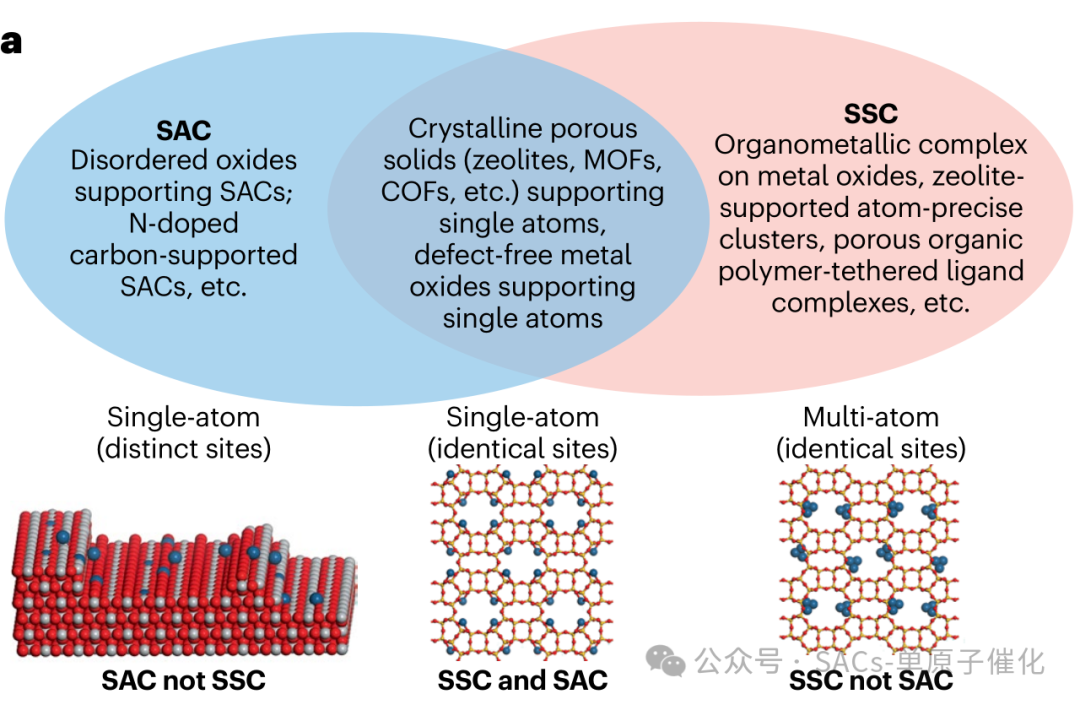
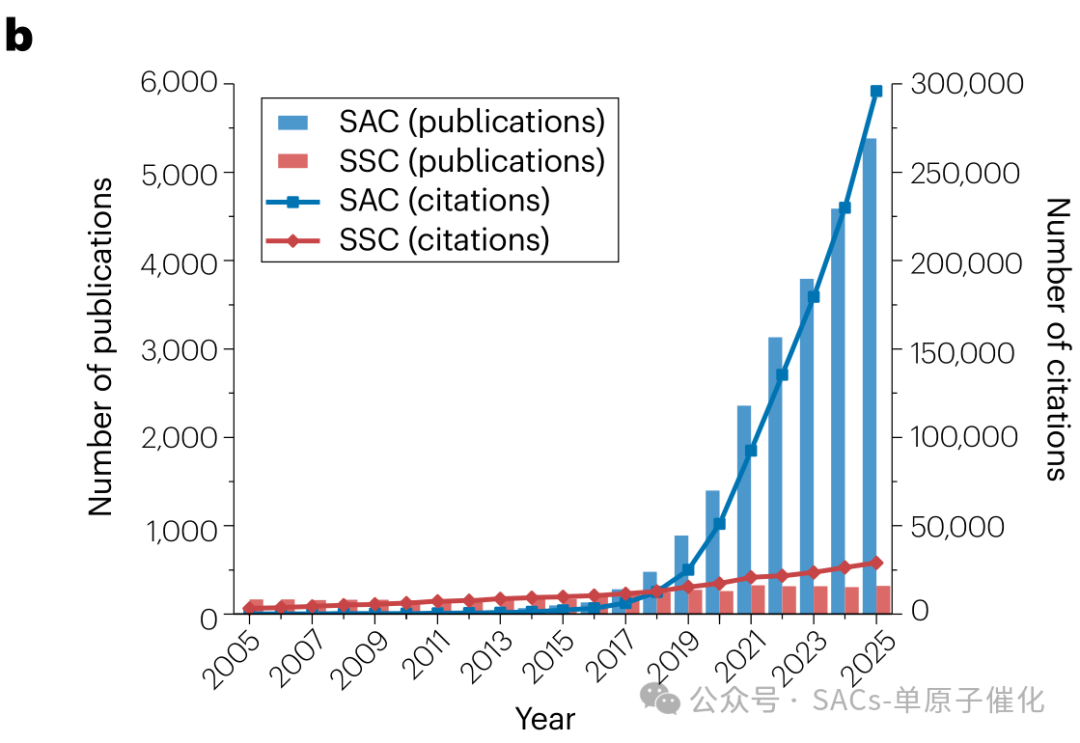
Figure 1. Relationship between single-atom catalysts and single-site catalysts, together with publication and citation trends in the field. Image source: original article.
03 How can a true single-site catalyst be identified?
Experimentally establishing a single-site catalyst is considerably more challenging than confirming a single-atom catalyst.
Atomic-resolution electron microscopy can reveal whether metal atoms are individually dispersed, but it cannot, by itself, demonstrate that all isolated atoms possess identical coordination environments and electronic structures. The article therefore proposes a set of complementary experimental criteria.
First, intrinsic activity should remain constant across catalyst loadings. For a series of catalysts with different metal loadings, the turnover frequency (TOF) should remain essentially unchanged. A systematic increase or decrease in TOF with metal content generally suggests the coexistence of nonequivalent catalytic sites. Loading-independent intrinsic activity, by contrast, supports the presence of uniform active centers.
Second, selective poisoning should produce a linear response. When probe molecules are used to progressively poison active sites, catalytic activity should decrease linearly with the amount of poison added. Such behavior indicates that the catalytic performance is dominated by a single type of active site.
Third, adsorption infrared spectroscopy should exhibit narrow spectral features. Fourier-transform infrared spectroscopy using CO or other probe molecules can provide information on the uniformity of local coordination environments. The article notes that an adsorption band with a full width at half maximum typically below 10 cm⁻¹ may serve as an important spectroscopic indicator of highly uniform coordination environments. Broad bands or overlapping multiple features, in contrast, suggest the coexistence of different atomic species.
Fourth, structural evidence should be validated under working conditions. In situ and operando X-ray absorption fine structure spectroscopy, temperature-programmed desorption, and related techniques can further assess whether the structure and adsorption energetics of the active sites remain uniform under realistic catalytic conditions.
Thus, observing isolated bright spots in HAADF-STEM images alone is not sufficient to claim that a catalyst is a single-site catalyst. For SACs, a combination of atomic-resolution STEM, X-ray absorption spectroscopy, and adsorption infrared spectroscopy can generally provide compelling evidence for atomic dispersion. To further establish that a SAC is also an SSC, researchers must answer a more demanding question: are all of these isolated atoms truly equivalent?
04 A representative example: why a single atom is not necessarily a single site
Carbon-supported Au catalysts for the industrial hydrochlorination of acetylene are discussed in the article as a representative case.
In situ XAFS and atomic-resolution STEM both demonstrate that Au species are atomically dispersed on the carbon support and that Au–Au bonds are absent. The catalyst therefore satisfies the fundamental definition of a single-atom catalyst.
However, Au(I) and Au(III) species coexist during the reaction, indicating that the Au sites do not possess identical structures or electronic states. Accordingly, this catalyst can appropriately be described as a single-atom catalyst, but it cannot be rigorously classified as a single-site catalyst.
This example clearly illustrates that “the metal atoms are isolated” and “all active centers are identical” represent two fundamentally different levels of structural definition.
05 Different future directions for the two catalyst classes
The authors note that single-atom catalysts now have a relatively clear definition and a comparatively mature characterization framework, and they are expected to remain an important focus in both fundamental research and industrial applications.
Key challenges include precise regulation of the local coordination environment of isolated metal atoms, increasing metal loading while retaining atomic dispersion, improving stability under reaction conditions, and developing scalable preparation methods for practical applications.
Single-site catalysts, by contrast, more closely resemble structurally idealized platforms for fundamental catalysis research. Highly uniform active centers can minimize interference from site heterogeneity, thereby facilitating the identification of intrinsic catalytic mechanisms and helping bridge the conceptual gap between homogeneous and heterogeneous catalysis.
Nevertheless, the precise synthesis and rigorous verification of truly single-site catalysts remain highly demanding. The article highlights the transformation of heterogeneous single-atom catalysts into genuine single-site catalysts through precise atomic engineering as an important long-term research direction.
06 From standardized terminology toward more verifiable catalysis
The significance of this Comment extends beyond drawing a conceptual boundary between two frequently used terms. More fundamentally, it emphasizes that catalyst nomenclature should be matched by experimentally verifiable structural evidence.
A single-atom catalyst describes the geometric isolation of metal species, whereas a single-site catalyst describes the structural and energetic uniformity of catalytic sites. The former does not automatically imply the latter, and the latter does not require the active unit to consist of only one metal atom.
Researchers are therefore encouraged to distinguish these concepts explicitly in scientific writing and to validate active-site identity and catalytic behavior through complementary approaches, including catalytic kinetics, probe-molecule experiments, and in situ or operando characterization.
Only when the field moves beyond simply demonstrating “atomic dispersion” toward active sites that are well-defined, experimentally verifiable, and controllable can single-atom catalysis more fully realize its potential to bridge fundamental catalytic science and industrial application.
Original article:
https://www.nature.com/articles/s41570-026-00882-z

