Recently, Academician Tao Zhang, Researcher Aiqin Wang, Associate Researcher Leilei Kang and co-workers from our laboratory, in collaboration with Professor Tao Yang’s team at Xi’an Jiaotong University, developed a catalyst featuring isolated Pd3 sites. This work provides a new strategy for the efficient selective hydrogenation of acetylene under ethylene-rich conditions.
The selective hydrogenation of acetylene is widely used to remove trace acetylene impurities from ethylene-rich streams, typically containing 0.5–2.0 vol.% acetylene, in order to meet the requirements of downstream ethylene polymerization. Currently, supported Pd–Ag alloy nanoparticle catalysts are mainly used in industry. However, their ethylene selectivity remains relatively low when acetylene approaches complete conversion. Since Academician Zhang Tao’s team first proposed the concept of single-atom catalysis in 2011 (Nature Chemistry, 2011), single-atom Pd-based catalysts have been widely applied in acetylene selective hydrogenation and have shown significantly improved selectivity compared with nanoparticle catalysts. Nevertheless, the weakened adsorption of H2 and acetylene on single-atom catalysts often leads to a loss of activity. Therefore, developing acetylene selective hydrogenation catalysts that combine both high activity and high selectivity remains a major challenge.
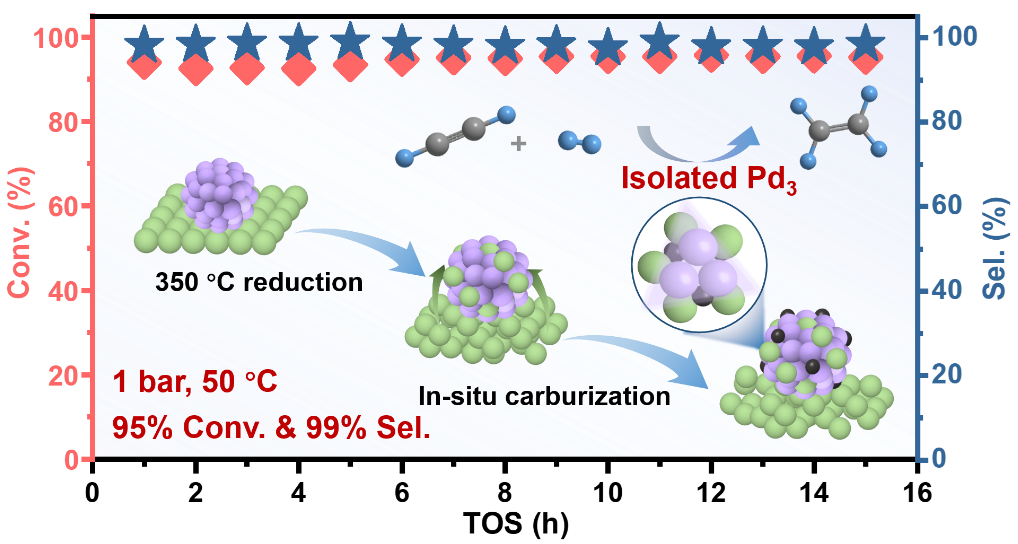
In this work, a catalyst with isolated Pd3 sites was successfully constructed by modifying Pd nanoparticles on Pd/Al2O3 with partially reduced GaOx, followed by in situ carburization under the reaction atmosphere. Under mild reaction conditions of 50 °C and 1 atm, the catalyst achieved 95% acetylene conversion and 99% ethylene selectivity, outperforming the best reported Pd-based catalysts. Experimental results and theoretical calculations reveal that the partially reduced GaOx species on the Pd surface not only isolate and stabilize the Pd3 geometric structure, but also regulate the electronic properties of Pd through electron transfer from Ga to Pd. This enhances acetylene adsorption while weakening ethylene adsorption, thereby improving both activity and selectivity. This work challenges the conventional understanding that Pd3 sites exhibit high activity but low selectivity, and demonstrates for the first time that isolated Pd3 sites can deliver both high activity and high selectivity in acetylene selective hydrogenation. The findings not only expand the concept of single-atom catalysis, but also provide new insights for the design of industrial catalysts.
The related research article, entitled “Construction of Isolated Pd3 Geometry on GaOx-Modified Pd/Al2O3 as a Highly Active and Selective Catalyst for Semihydrogenation of Acetylene,” was recently published in the Journal of the American Chemical Society. The co-first authors of this work are Rizheng Jing, a Ph.D. student from Group 1502 of our laboratory, and Chen Liang, a Ph.D. student from Xi’an Jiaotong University. This work was supported by the National Key R&D Program of China, the National Natural Science Foundation of China Basic Science Center Program for Single-Atom Catalysis, and the National Natural Science Foundation of China.
Text/Figures by Rizheng Jing and Leilei Kang
Article link: https://pubs.acs.org/doi/10.1021/jacs.6c05181

