Recently, the team led by Academician Tao Zhang and Prof. Aiqin Wang, in collaboration with Prof. Yanggang Wang from Southern University of Science and Technology, reported new progress in the study of single-atom catalysts for selective hydrogenation reactions.
Since the concept of “single-atom catalysis” was first proposed in 2011 (Nat. Chem., 2011, 3, 634), Academician Tao Zhang and Prof. Aiqin Wang’s team has been devoted to regulating the coordination environment of single-atom catalysts. The team has established correlations between the first-shell M1–O/Nx coordination numbers, the oxidation states of single atoms, and their hydrogenation activity (Nat. Commun., 2019, 10, 4500; Nat. Commun., 2021, 12, 3295). They have also developed in situ methods to monitor and regulate the dynamic evolution of coordination environments in single-atom catalysts (J. Am. Chem. Soc., 2021, 143, 14530; J. Am. Chem. Soc., 2022, 144, 12062; Nat. Catal., 2022, 5, 1145; J. Am. Chem. Soc., 2024, 146, 695; J. Am. Chem. Soc., 2024, 146, 11955). These efforts have led to a systematic understanding of how the local coordination environment of single-atom catalysts affects catalytic performance (Acc. Chem. Res., 2025, 58, 1878).
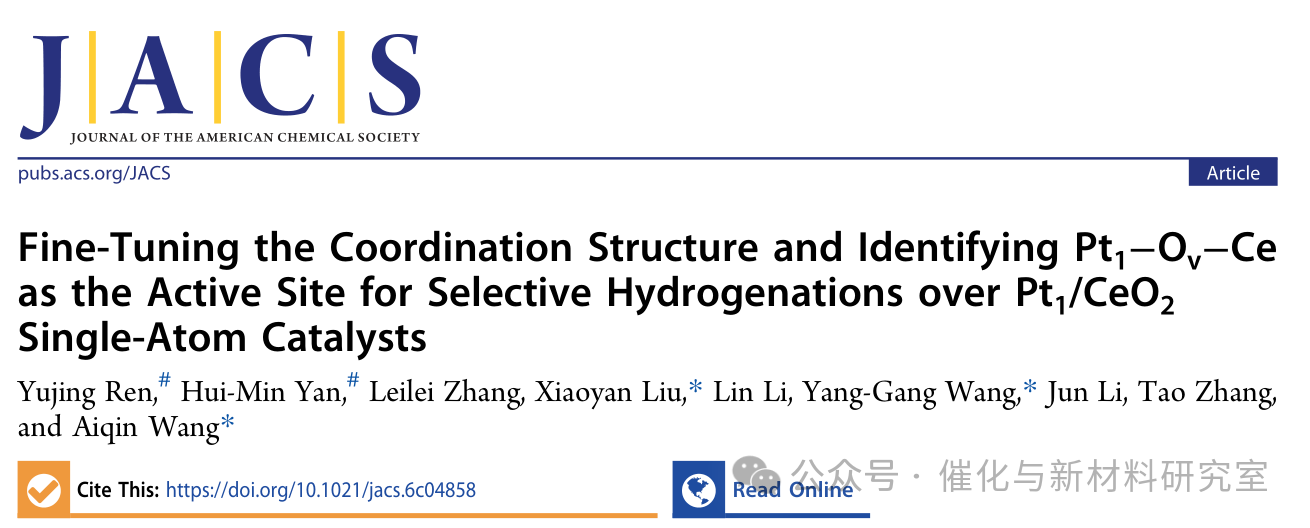
Building on these previous studies, the present work used Pt1/CeO2 single-atom catalysts as a model system. Through a rapid thermal treatment strategy, the local coordination environment of Pt single atoms was precisely tuned. The study established a linear correlation among the Pt–O coordination number, electronic structure, and catalytic activity in the selective hydrogenation of furfural and nitroarenes, further confirming that the local coordination environment of single atoms is a key structural descriptor for regulating catalytic performance.
By combining in situ spectroscopic characterization with density functional theory calculations, the researchers revealed the dynamic evolution of oxygen vacancies neighboring Pt atoms during the reaction. The results identified the Pt1–Ov–Ce site as the intrinsic active center for selective hydrogenation. This site can selectively adsorb and activate C=O and –NO2 groups, while the Pt₁ site activates H₂, thereby enabling highly active and highly selective hydrogenation transformations.
The study also quantitatively compared, for the first time, the intrinsic activity of Pt1–Ov–Ce sites with that of peripheral oxygen vacancy sites, denoted as Pt1–Ov. The results showed that Pt1–Ov–Ce sites exhibit significantly higher activity, demonstrating that the close cooperation between Pt single atoms and adjacent oxygen vacancies is crucial for efficient selective hydrogenation.
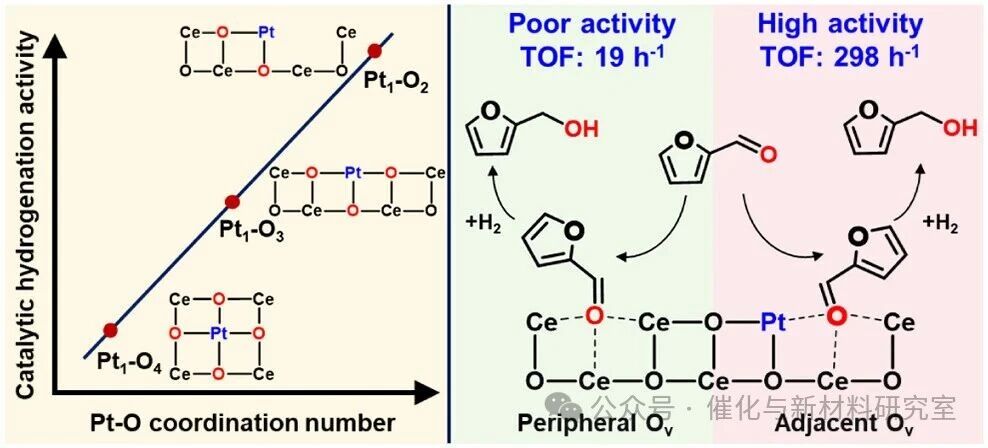
This work deepens the understanding of active centers in oxide-supported single-atom catalysts and provides guidance for the rational design of highly efficient selective hydrogenation catalysts.The research article, entitled “Fine-Tuning the Coordination Structure and Identifying Pt1–Ov–Ce as the Active Site for Selective Hydrogenations over Pt1/CeO2 Single-Atom Catalysts,” was recently published in the Journal of the American Chemical Society. The co-first authors are Dr. Yujing Ren, a Ph.D. graduate of our institute and currently an Associate Professor at Northwestern Polytechnical University, and Dr. Huimin Yan from Southern University of Science and Technology.
This work was supported by the National Key Research and Development Program of China, the Basic Science Center Program for Single-Atom Catalysis of the National Natural Science Foundation of China, and the National Natural Science Foundation of China.
Article link: https://pubs.acs.org/doi/10.1021/jacs.6c04858
Contributed by Research Group 1502

